Biography, Artist Statement and portrait
About
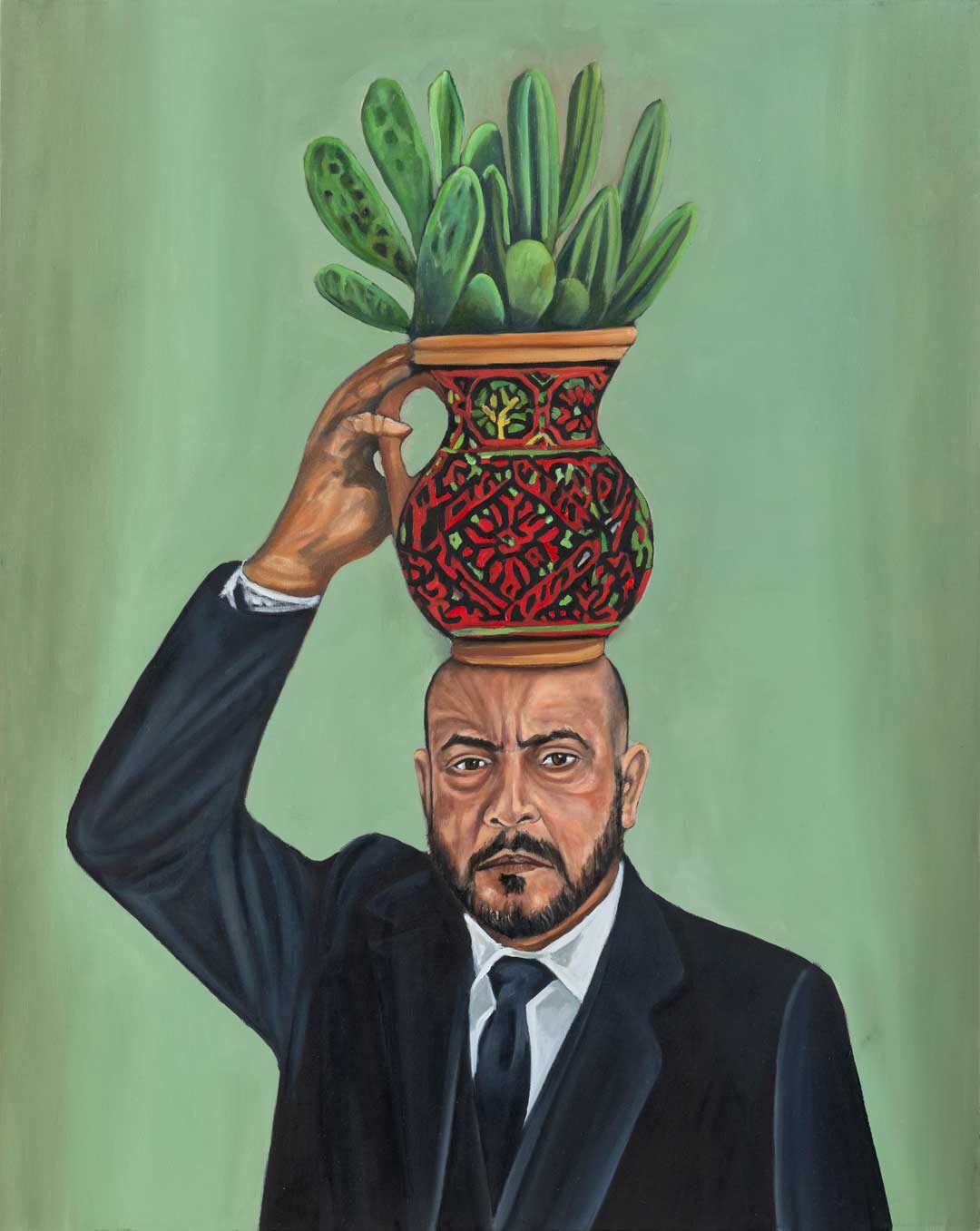
Fouad Agbaria
(b. 1981, Musmus) is a Palestinian visual artist living and working in Umm al-Fahm.
He holds a BFA from Bezalel Academy of Arts and Design, Jerusalem (2004), an MFA from the University of Haifa (2014), and an LLB from Ono Academic College (2023).
Since 2004, Agbaria has exhibited in solo and group exhibitions in museums, galleries and art institutions in Israel and abroad.
His practice moves across painting, drawing, installation and material-based work, exploring memory, landscape, identity, belonging and the relationship between personal experience and collective memory.
Recurring motifs include the prickly pear cactus, olive trees, rugs and ornament, cultivated land, domestic objects and the human figure.
Alongside his studio practice, Agbaria has taught art and participated in cultural committees and professional juries.
Since 2025, he has served as Administrative and Operations Manager of the Umm al-Fahm Museum of Art.
Artist Statement
My work grows out of a close relationship with land, place and memory.
I am interested in the point at which a landscape stops functioning as scenery and becomes a physical and psychological imprint: a smell after rain, a field remembered from childhood, the texture of soil, a domestic object, a plant that continues to survive.
I return repeatedly to images such as the prickly pear cactus, olive trees, rugs, ornament, animals, cultivated land and the human figure. These motifs are not fixed symbols. I dismantle, repeat and reconstruct them so that their meaning can shift from one work to another.
Memory, for me, is not a stable archive of the past; it is an active material that is constantly rebuilt in the present.
Painting remains central to my practice.
I work through layers of color, free brushstrokes, incisions and textured surfaces, allowing color to carry rhythm, light and time rather than simply describe form.
In recent years my practice has expanded beyond the canvas into installations and material works using iron, soil, plants, glass, textiles and other natural or industrial materials. The material itself becomes a witness: it bears traces of place, displacement, fragility and persistence.
The rug is one of the recurring structures in my work.
It connects domestic memory, Islamic ornament, Arabic calligraphy and the visual language of Palestinian embroidery.
At the same time, I often interrupt its apparent harmony with images or materials that introduce tension, vulnerability or threat.
The prickly pear is similarly transformed: rooted and resilient, yet also fragmented, displaced and capable of regeneration.
I do not seek to illustrate a single political or documentary message. I use personal memory as an entry point into broader questions of identity, belonging, time and the relationship between human beings and the places they inhabit. My work moves between the intimate and the collective, between beauty and fracture, and between what has disappeared and what continues to insist on being present.
Key Bodies of Work / Series Texts

Memory & Landscape
Landscape in Agbaria’s work is not treated as neutral scenery. Fields, hills, olive groves and agricultural spaces are reconstructed through memory, color and sensation. Personal childhood experience intersects with broader cultural memory, allowing the landscape to function as a psychological and historical space rather than a fixed geographical view.
Prickly Pear / Sabra
The prickly pear has appeared in Agbaria’s work for many years, moving between realism, expression, abstraction and installation. It represents endurance and continuity, but Agbaria repeatedly breaks apart its familiar form. Severed pads, exposed roots and displaced plants turn the cactus into a changing image of memory, fragility, survival and regeneration.
Rugs, Ornament & Domestic Space
Agbaria’s rug works draw on domestic memory, Islamic ornament, Arabic calligraphy and Palestinian textile traditions. The rug can suggest home, intimacy and spirituality, yet its visual harmony is often interrupted by contemporary objects, signs of threat or physical transformation. Recent works extend the painted rug into laser-cut iron installations, shifting it from soft textile to rigid, suspended structure.
Material & Installation
In Agbaria’s installations, material is not merely a carrier of an image. Iron, soil, plants, glass, rope and textiles become active elements that hold traces of place and bodily experience. These works extend the artist’s long engagement with memory from representation toward physical presence.
Portraits & Figures
Portraits and human figures function as witnesses to time. Rather than isolated likenesses, they often merge with surrounding color, pattern and landscape. Self-portraiture, family figures and anonymous bodies become part of a broader visual autobiography in which the present looks back at what has passed.